A team of scientists deployed instruments onto an ice shelf in Antarctica and discovered that pools of meltwater were causing the ice to bend and break. While this phenomenon had been anticipated by scientists, it had never been directly observed until now. This finding is concerning because it suggests that as climate change advances and more melting occurs, fragile ice shelves in Antarctica could collapse, contributing to the global rise in sea levels.
Alison Banwell, a scientist at the Cooperative Institute for Research in Environmental Sciences (CIRES) at the University of Colorado Boulder and the lead author of the study published in the Journal of Glaciology on May 4, emphasized the crucial role of ice shelves in maintaining the overall stability of the Antarctic Ice Sheet. She explained that while scientists had previously theorized that the weight of surface meltwater could lead to ice shelf fractures, this study provided the first direct observation of the process.
Doug MacAyeal, a Professor Emeritus of Geophysical Sciences at the University of Chicago and co-author of the paper, suggested that this process likely played a role in the collapse of the Larsen B Ice Shelf in 2002, during which over 1,000 square miles of Antarctic ice disintegrated into the ocean within a matter of weeks.
Pooling evidence
Across Antarctica, expansive sheets of glacier ice float atop the ocean, known as ice shelves, thought to play a crucial role in maintaining the stability of inland glaciers. However, an increasing number of these ice shelves are showing signs of collapse.
In 2019, Banwell and her team embarked on a research expedition to the George IV Ice Shelf, identified as one of the vulnerable ice shelves in Antarctica. They deployed time-lapse cameras and GPS sensors to monitor the ice dynamics over a year, encompassing the seasonal cycle of freezing and thawing.
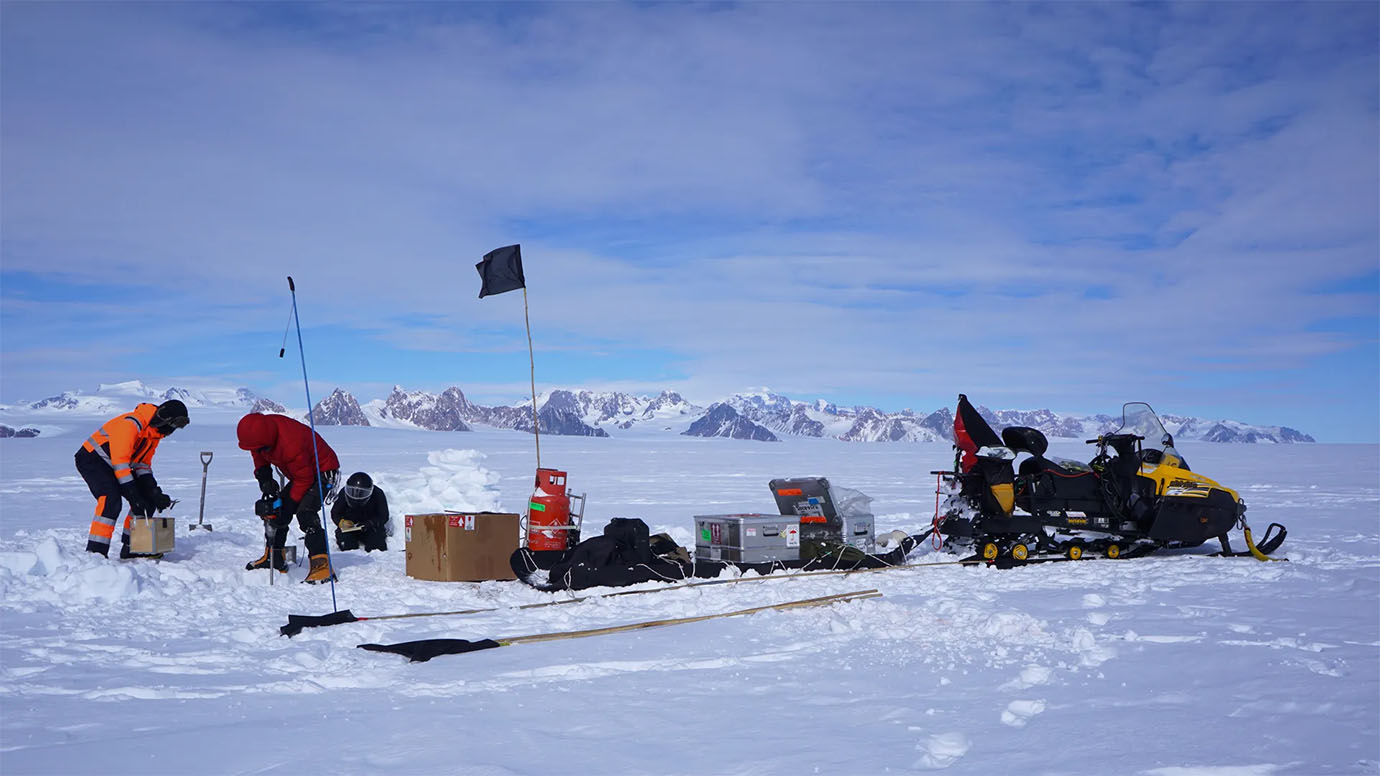
Due to the COVID-19 pandemic, their return was delayed by over a year. Upon revisiting in late 2021, they found that several monitoring stations had been lost, yet some instruments survived, providing valuable data.
The research outlines the process by which warmer air temperatures lead to surface ice melting on the ice shelf, forming pools of liquid water that concentrate weight in specific areas. This water seeps into cracks in the ice, gradually widening them over time, akin to cracks spreading from a pothole in a road. Throughout the summer, these pools fill and drain repeatedly, causing the ice shelf to rise and fall by approximately a foot each time, further weakening its structure.
MacAyeal likened ice to a fragile form of glass, highlighting its susceptibility to stress. Eventually, the accumulated pressure causes the ice to fracture abruptly, as indicated by a sudden change in altitude recorded by the GPS stations. Time-lapse footage captured by the cameras illustrates how these meltwater pools exert stress on the ice, leading to fractures.
The researchers suggest that this cycle of thawing and freezing likely played a pivotal role in the collapse of the Larsen B Ice Shelf in 2002, the largest recorded ice shelf breakup. Satellites had previously detected numerous meltwater pools on the ice shelf before its collapse.
Since 1880, global sea levels have risen by eight to nine inches, with Antarctic ice melt contributing significantly to this trend. The loss of ice shelves raises concerns among scientists about further destabilizing the situation.
Banwell emphasized the importance of these observations in enhancing models to better predict which Antarctic ice shelves are most vulnerable to collapse in the future. Co-authors from the University of Cambridge and the University of Oxford also contributed to the study.