In recent years, global warming has increasingly affected the Antarctic ice sheets, with the ice in Antarctica melting faster than previously thought, particularly in West Antarctica compared to East Antarctica.
An international research team led by the Alfred Wegener Institute has discovered that this discrepancy may be rooted in the ice formation process. Sediment samples from drill cores and complex climate and ice-sheet modeling reveal that Antarctica's permanent glaciation began around 34 million years ago. However, contrary to prior beliefs, this initial glaciation was limited to East Antarctica. It took another 7 million years for ice to advance toward the West Antarctic coasts. These findings, published in the journal Science, highlight the differing responses of East and West Antarctica to external climate forces.
Approximately 34 million years ago, Earth experienced a major climate shift from a greenhouse world with little continental ice to an icehouse world with large, permanently glaciated areas, including the Antarctic ice sheet. Until now, data from key regions, especially West Antarctica, were insufficient to detail this transition.
Researchers from the Alfred Wegener Institute, Helmholtz Centre for Polar and Marine Research, in collaboration with various international institutions, have addressed this knowledge gap. They retrieved a drill core using the MARUM-MeBo70 seafloor drill rig from a location offshore the Pine Island and Thwaites glaciers on the Amundsen Sea coast of West Antarctica. This core showed no signs of ice during Antarctica's initial glaciation phase, indicating that the first extensive and permanent glaciation began in East Antarctica, while West Antarctica remained ice-free, covered by dense forests, and experiencing a cool-temperate climate.
The paleoclimate modelers at AWI, combining new and existing data, determined that the first permanent ice formed in the coastal regions of East Antarctic Northern Victoria Land, where moist air masses and rising mountains created ideal conditions for permanent snow and ice cap formation. The ice sheet then spread into the East Antarctic hinterland, reaching West Antarctica about seven million years later, once conditions allowed for ice advancement to the West Antarctic coast.
The study demonstrates the starkly different responses of East and West Antarctica to external climatic changes, with West Antarctica requiring only slight warming to melt again. These findings are crucial for understanding the extreme climate transition from the greenhouse climate to the current icehouse climate and improving climate models to more accurately simulate the interactions between ice, ocean, and atmosphere.
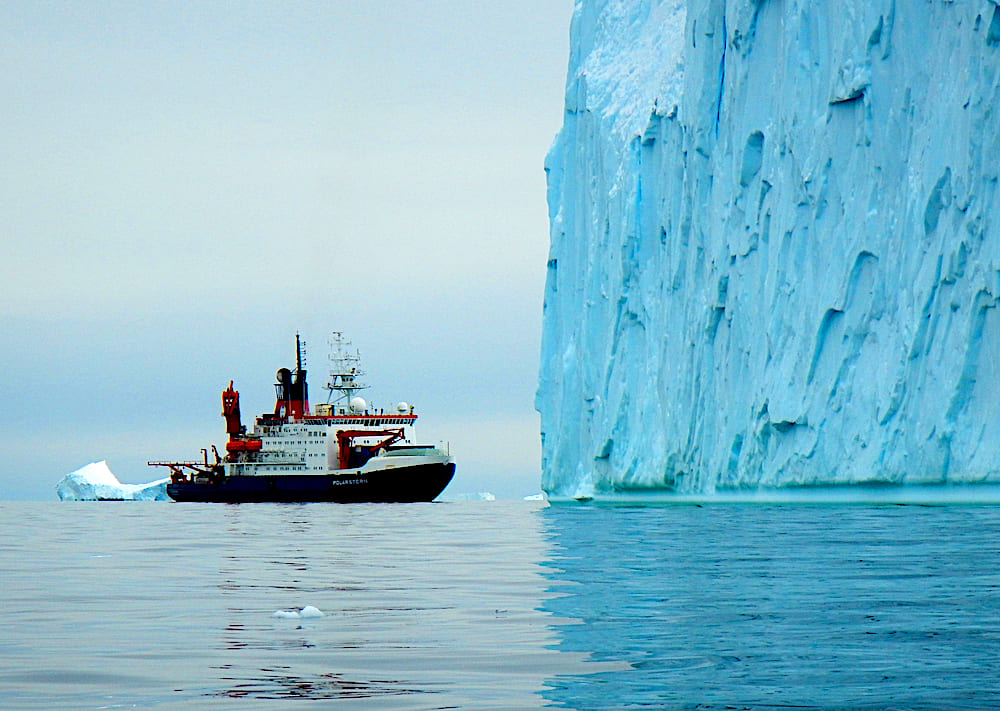
The researchers closed this knowledge gap using a unique drill core retrieved during the 2017 expedition PS104 on the research vessel Polarstern in West Antarctica. The MARUM-MeBo70 drill rig's rotating cutterhead enabled drilling about 10 meters into the seabed to retrieve the samples. The research project, including the Polarstern expedition PS104, was funded by the AWI, MARUM, the British Antarctic Survey, and the NERC UK-IODP Programme.